Portable Tennis Ball Hopper Cart: 150/180 Balls, Swivel
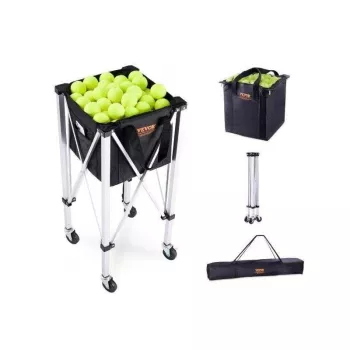
Portable Tennis Ball Hopper Cart with 360° Swivel Wheels – Holds 150/180 Balls
A rolling ball cart can keep practice moving when feeding drills, running clinics, or picking up after group sessions. This portable tennis ball hopper cart pairs a high-capacity basket (150/180 balls) with 360° swivel wheels to help cut down on repetitive bending, speed up resets between drills, and keep balls organized as you move from court to court. For more guidance, see Sturdy & Reliable Ball Hoppers & Baskets ~ Player’s Guide.
What This Ball Hopper Cart Is Built For
- Court-efficient ball management for lessons, team practices, and high-rep drills
- Rolling mobility for moving between baseline, service boxes, and adjacent courts without carrying a full basket
- Fast pickup and quick repositioning during multi-player feeding and clinic rotations
- A tidy courtside “home base” for balls, cones, and small training gear
Key Features That Matter on Court
- 360° swivel wheels for quick direction changes around the net post, benches, and fences
- High ball capacity options (150/180) to reduce refill trips during long sessions
- Cart-style height to cut down on repetitive bending when loading and feeding balls
- Portable design that’s easier to transport than bulky teaching carts
When practice intensity climbs, small inefficiencies add up. A cart you can steer easily—without lifting—helps keep the pace consistent, especially during feeding sequences where players rotate quickly and the next ball needs to be ready on time. For further reading, see [PDF] Summer 2026 – Madison School & Community Recreation.
Capacity and Session Planning (150 vs 180 Balls)
- 150 balls typically covers most individual lessons and small-group drills without constant restocking
- 180 balls can be helpful for high-volume feeding, multi-court clinics, and team warmups
- Higher capacity supports drill consistency—less downtime collecting and more time hitting
- Ball count needs often scale with: number of players, drill length, and whether balls are being recycled continuously or used in batches
Quick Capacity Guide
| Session Type | Suggested Capacity | Why It Helps |
|---|---|---|
| Individual lesson (1–2 players) | 150 balls | Enough volume for repeated feeds with minimal interruptions |
| Small group (3–6 players) | 150–180 balls | Supports longer rotations and less frequent resets |
| Clinic / team practice | 180 balls | Better for high-rep drills and multi-station setups |
Swivel Wheels: Handling, Stability, and Court Surfaces
- Swivel wheels make it easier to maneuver in tight spaces and change directions without lifting the cart
- Smooth rolling reduces time and effort when moving a full load of balls along the fence line
- For best stability, keep heavier items low and centered if carrying extras (cones, towels, small bags)
- On gritty or uneven surfaces, periodic wheel cleaning can help maintain smooth rolling and reduce drag
In practical terms, 360° swivel wheels matter most when you’re navigating the narrow lane between the doubles alley and the fence, or when you need a quick pivot at the net post to keep a feeding line moving. Instead of dragging, lifting, and setting the cart down again, you can steer it like a piece of courtside equipment that’s meant to stay “in play.”
Using a Hopper Cart for Faster Drills
- Set the cart near the feeding position (baseline, mid-court, or service line) to keep transitions quick
- Pre-sort balls before practice so each drill starts immediately (e.g., one basket for serves, one for groundstrokes when running stations)
- Use the cart as a consistent target area for players to return stray balls between points
- For clinics, position the cart near the next station to reduce traffic and keep pathways clear
If you structure practice around progressive patterns—crosscourt control, down-the-line change-ups, then point starts—a rolling hopper cart helps maintain rhythm. Less time spent collecting means more reps under realistic timing, which aligns well with modern practice planning and player development principles emphasized by organizations like USTA Player Development.
Setup, Transport, and Storage Tips
- Confirm the cart fits in the intended storage area (garage corner, coach trunk space, facility closet)
- If transporting in a vehicle, plan for a stable spot to prevent shifting (especially when loaded)
- Store balls dry and out of direct heat to extend their usable practice life
- Do a quick pre-session check: wheel spin, fasteners, and basket integrity to avoid mid-drill interruptions
Who Benefits Most
Product Details and Where to Get It
Product: Portable Tennis Ball Hopper Cart with 360° Swivel Wheels – Holds 150/180 Balls
More In-Stock Finds
- Vintage Leather Crossbody Shell Bag (in stock) for carrying small personal items to and from the courts
- 39mm Diver GMT Enamel Dial Automatic Mechanical Watch with Ceramic Bezel (in stock)
- 38mm Luxury Sport Automatic Watch with Oil Pressure Grid Dial (in stock)
FAQ
How many tennis balls does this cart hold?
It’s available in high-capacity options that hold approximately 150 or 180 tennis balls. Choose 150 for most lessons and small-group drills, and consider 180 when you’re feeding high volume in clinics, team practices, or multi-station setups.
Do swivel wheels make a difference compared with fixed wheels?
Yes—360° swivel wheels improve maneuverability, making tight turns and quick repositioning easier without lifting the cart. On dusty or gritty courts, keeping the wheels clean helps maintain smooth rolling and reduces drag.
Is a rolling hopper cart better than a handheld hopper basket?
A handheld hopper basket works well for short sessions and minimal gear, especially when you’re moving frequently and carrying light. A rolling hopper cart is often better for high-rep feeding because it reduces carrying, minimizes bending, and speeds up transitions between drills.






Leave a comment